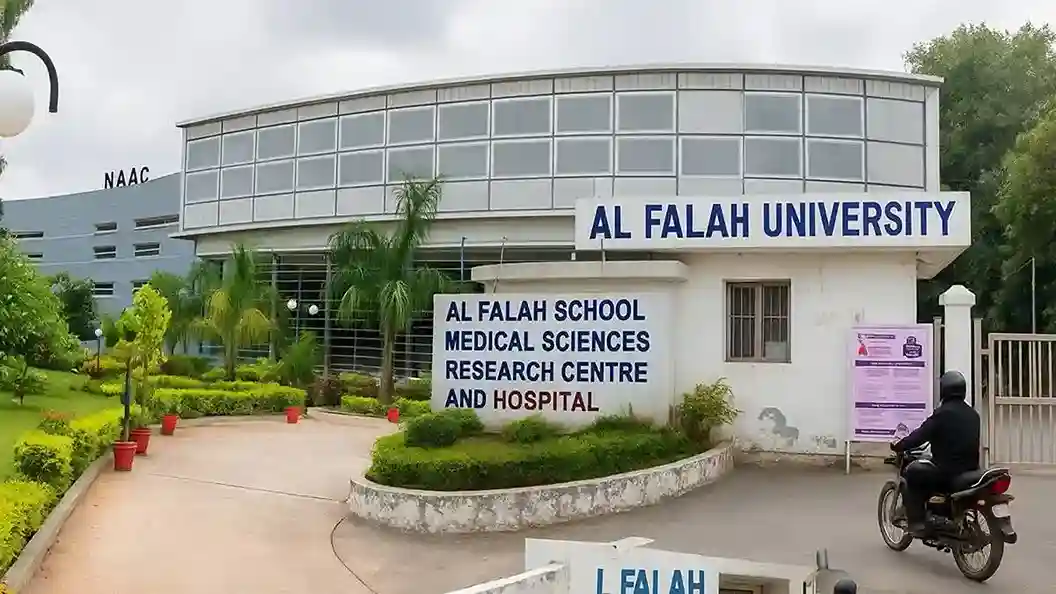
The probe into the deadly Red Fort blast of 10 November 2025 has expanded far beyond the original crime scene, exposing a web of radicalisation, financial irregularities, and questionable institutional practices centred around Al-Falah University in Faridabad. The widening investigation—spanning Delhi, Haryana, and Madhya Pradesh—now points to a complex “white-collar terror module” involving doctors, university officials, and a decades-old fraud case that has suddenly regained national attention.Click Here To Follow Our WhatsApp Channel
Deadly Blast and the Unfolding Terror Plot
A powerful car bomb exploded near the Red Fort Metro Station on 10 November, killing 13 people and injuring dozens. The explosion, linked to Pakistan-based Jaish-e-Mohammed (JeM), was reportedly part of a wider plan involving as many as 32 vehicle-borne IEDs. Investigators believe the attacks were timed to coincide with the Babri Masjid demolition anniversary, raising fears of an attempt to destabilise the capital during a sensitive period.
The plot thickened further when Delhi Police uncovered links to a group of radicalised medical professionals from Al-Falah University of Medical Sciences and Research Centre in Faridabad. Among those arrested were Dr Shaheen Saeed, Dr Mujammil Shakeel, and Dr Shaheen Shahid, whose homes yielded coded diaries, notebooks, and evidence of two years of covert planning.
Al-Falah University Under the Scanner
The arrests quickly placed Al-Falah University under intense national scrutiny. What was initially viewed as an isolated case of radicalisation has now expanded into a wider examination of the university’s governance, recruitment practices, and financial structure.
Investigators are looking closely at the role of the university’s founder and managing trustee, Javed Ahmed Siddiqui, after discovering that several of the arrested doctors had close ties with departments under his control. Siddiqui’s long corporate history, which includes directorships in multiple companies linked to the Al-Falah Trust, has come under renewed scrutiny—especially in light of his past criminal record.
On 12 November, the university’s official website was hacked by a group calling itself the Indian Cyber Alliance, which posted warnings against “radical Islamic activities.” The cyber-attack pushed the university deeper into the national spotlight, drawing attention to gaps in its oversight mechanisms.
A 2000 Fraud Case Returns to Haunt Siddiqui
At the centre of the revived controversy is a ₹7.5 crore fraud case from 2000 linked to Al-Falah Investments, a company Siddiqui directed since 1992.
According to the FIR (No. 43/2000, New Friends Colony Police Station), Siddiqui and his brother Saood Ahmed allegedly lured investors with promises of high returns, then forged documents to convert deposits into shares and diverted the funds into personal accounts. The case involved IPC sections related to cheating, forgery, breach of trust, and criminal conspiracy.
Key details from the case include:
- Arrest & Jail Term: Siddiqui was arrested in 2001 and spent more than three years in jail.
- Bail Rejected: In 2003, the Delhi High Court refused bail after forensic reports confirmed forged signatures on share certificates.
- University Response: The university’s legal advisor, Mohd Razi, dismissed the old allegations as “baseless,” claiming no role in staff recruitment.
The timing of the resurfaced case is significant, as the Enforcement Directorate (ED) has already been investigating the university’s funding sources for possible irregularities.
A Network of Nine Companies Under Review
Ministry of Corporate Affairs records show Siddiqui as a director in nine firms, all linked to the Al-Falah Trust and sharing the same Okhla address. These include entities in education, engineering, software, consultancy, energy, and export-import sectors.
Companies Connected to Siddiqui
| Company Name | Sector | Notes |
|---|---|---|
| Al-Falah Investments Ltd. | Finance | Central to the 2000 fraud case. |
| Al-Falah School of Engineering & Technology | Education | Precursor to the university. |
| Brown Hills College of Engineering & Technology | Education | Part of the trust’s expansion. |
| Al-Falah School of Education & Training | Education | NAAC A-grade claim now under review. |
| Al-Falah Software Solutions Pvt. Ltd. | IT | Possible overlap with university systems. |
| Al-Falah Energy Ventures | Energy | New venture post-fraud conviction. |
| Al-Falah Export-Import Pvt. Ltd. | Trading | Being checked for funding trails. |
| Al-Falah Consultancy Services | Consulting | May link operations across firms. |
| Al-Falah Medical Research Foundation | Health Research | Directly connected to arrested doctors. |
Agencies suspect that this wide corporate structure may have enabled financial overlaps, though no direct terror-funding charge has been made against Siddiqui yet.
Key Suspects and Expanding Investigations
DNA analysis confirmed that the Red Fort bomber was Dr Umar un Nabi, a fugitive associated with the Faridabad explosives seizure of 2,900 kg earlier this year. He went missing shortly after the arrest of the doctors, raising questions about a deeper network.
Another individual, Nisar Ul Hassan, earlier labelled a “potential time-bomb” by the J&K Lieutenant Governor, was also found to be linked to Al-Falah University, further complicating the picture.
Raids have now extended to:
- Siddiqui’s office in Okhla, Delhi
- His hometown Mhow in Madhya Pradesh
- Residences of doctors, administrators, and staff connected to the university
The widening scope suggests the possibility of sleeper cells embedded within academic institutions.
Regulatory Concerns and National Security Implications
The scandal has prompted fresh questions about how Al-Falah University received approval for a medical college in 2019 despite Siddiqui’s criminal history and unresolved financial cases.
The National Assessment and Accreditation Council (NAAC) has issued a show-cause notice after finding that the university falsely claimed accreditation on its website—adding another layer of regulatory concern.
Security agencies believe the case reveals a dangerous intersection of higher education, financial crime, and radicalisation, where professional respectability was used to mask extremist activities.
Conclusion: A Case With Far-Reaching Consequences
As of 15 November 2025, no further explosions have occurred, but Delhi remains on high alert. For investigators, the blast is no longer just a terror attack—it is a window into how educated professionals, corporate networks, and institutional gaps can converge to create threats far larger than a single bombing.
With multiple agencies involved and new leads emerging daily, the Red Fort blast case is shaping into one of India’s most significant counterterror investigations in recent years, raising uncomfortable questions about oversight, accountability, and national security.
You Might Also Like:
Islam’s Unique Civilisation: Unity of Faith, Culture and History
Iran Offers Condolences to India Over Delhi Red Fort Blast, NIA Launches Full Terror Probe
Imam Mohammad Ishityaq’s Brother Denies Terror Allegations as NIA Intensifies Delhi Blast Probe