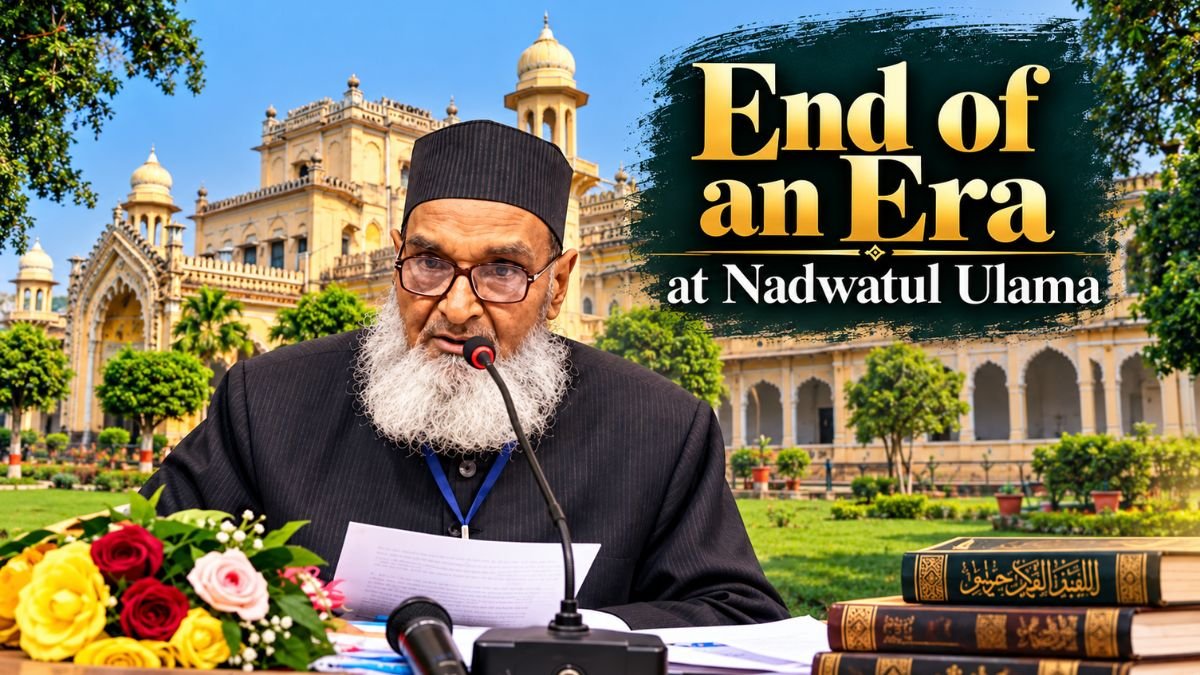
Dr Saeed-ur-Rahman Azmi Nadwi Dies at 92: End of an Era at Nadwatul Ulama
Edited : By Altaf Nadwi
The Islamic scholarly and literary world is mourning the death of Dr Saeed-ur-Rahman Azmi Nadwi, a respected Islamic scholar, teacher, writer and Arabic language expert who spent most of his life serving Darul Uloom Nadwatul Ulama in Lucknow. Click Here To Follow Our WhatsApp Channel
Dr Azmi Nadwi passed away in Lucknow on October 7, 2026, at the age of 92 after a prolonged illness.
His death marks the end of a long chapter in the history of Nadwatul Ulama. For more than seven decades, he remained closely connected with the institution, first as a student and teacher and later as one of its senior administrators.
He served as the Mohtamim (principal/administrator) of Darul Uloom Nadwatul Ulama from 2000 and became widely known for his contribution to Islamic education, Arabic literature and journalism.
Early life and education
Dr Saeed-ur-Rahman Azmi Nadwi was born on May 14, 1934, in Mau, Uttar Pradesh.
He received his early religious education at Jamia Miftahul Uloom in Mau. In 1952, he moved to Lucknow and joined Darul Uloom Nadwatul Ulama for higher studies.
At Nadwa, he studied under several well-known scholars and teachers and developed a strong interest in the Arabic language, Islamic studies and literature.
After completing his education, he joined Nadwa as a teacher. His connection with the institution would continue for more than seven decades.
A lifetime at Nadwatul Ulama
Dr Azmi Nadwi’s life was closely linked with Nadwatul Ulama.
He began his journey there as a student before becoming a teacher and later taking on important academic and administrative responsibilities.
He became a senior teacher of Arabic and literature and later headed the institution’s Arabic department.
Between 1993 and 1999, he served as the Dean of the Faculty of Arabic Language and Literature.
In 2000, he was appointed Mohtamim of Darul Uloom Nadwatul Ulama.
During his years as an administrator, he continued to support the institution’s traditional Islamic education while also encouraging the study of Arabic language, literature and contemporary intellectual subjects.
His long association with Nadwa made him one of the institution’s most recognisable senior scholars.
A respected Arabic scholar
Dr Azmi Nadwi was particularly respected for his knowledge of Arabic language and literature.
He was not only a teacher but also a writer, editor and translator. His work helped introduce Indian Islamic scholarship to Arabic-speaking readers in different parts of the world.
His writings covered Islamic thought, education, culture, Arabic literature and contemporary social and intellectual issues.
Among his known works is Islam aur Maghrib (Islam and the West). He also wrote several other books and academic articles in Urdu and Arabic.
His writing reflected his deep knowledge of traditional Islamic scholarship as well as his understanding of modern intellectual issues.
His contribution to Arabic journalism
Journalism was another important part of Dr Azmi Nadwi’s life.
He was closely associated with Al-Baas-ul-Islami, the Arabic monthly published by Nadwatul Ulama.
He worked with the publication for many years and later became its chief editor.
Through the magazine, Islamic scholarship from India reached readers in the Arab world and other parts of the international Muslim community.
His editorial work helped strengthen the connection between Indian Islamic scholars and Arabic-speaking intellectual circles.
He was also associated with other Arabic publications, including Al-Raid, and contributed articles and research papers to various journals.
A link between tradition and the modern world
One of the important features of Dr Azmi Nadwi’s scholarly career was his ability to engage with both traditional Islamic learning and modern intellectual questions.
His education was rooted in the classical Islamic tradition, but his writings also dealt with subjects such as Western thought, education, society and contemporary challenges facing Muslims.
Through his teaching and writing, he encouraged students to develop a strong command of Arabic while remaining aware of changes taking place in the wider world.
This approach was closely connected with the educational tradition of Nadwatul Ulama.
National recognition
Dr Azmi Nadwi’s contribution to Arabic language and literature received national recognition.
In 1994, the Government of India honoured him with the Presidential Award for his contribution to Arabic language and literature.
He later received several other honours for his academic and educational work.
In 2013, the Institute of Objective Studies in New Delhi honoured him with a Lifetime Achievement Award.
In 2019, he was awarded an honorary D.Litt. degree by Khwaja Moinuddin Chishti Language University in Lucknow.
These honours reflected the recognition he received for his long contribution to education, Arabic studies and Islamic scholarship.
Role in the Muslim Personal Law Board
Dr Azmi Nadwi also played a role in wider Muslim educational and religious institutions.
He was among the founding members of the All India Muslim Personal Law Board (AIMPLB).
His knowledge of Islamic law, education and social issues made his advice valuable in discussions concerning the Muslim community and religious affairs.
However, his main public identity remained that of a scholar and educator associated with Nadwatul Ulama.
His connection with senior Nadwa scholars
Dr Azmi Nadwi also had close links with several major scholars of Nadwatul Ulama.
He was particularly associated with Maulana Abul Hasan Ali Nadwi, popularly known as Ali Mian Nadwi.
Their association was an important part of his intellectual journey.
Dr Azmi Nadwi later wrote about his experiences and association with Ali Mian Nadwi, helping preserve memories of one of the most influential scholars associated with Nadwa.
His writings on senior scholars also provide an important record of the intellectual life of the institution.
More than a teacher
For generations of students, Dr Azmi Nadwi was more than an administrator.
He was a teacher, mentor and guide.
Those who worked with him often remembered his disciplined lifestyle, punctuality, simple habits and commitment to education.
He remained closely involved in the academic and religious life of Nadwatul Ulama even in his later years.
His long service also meant that several generations of students passed through his classrooms and benefited from his knowledge of Arabic and Islamic studies.
An international scholarly presence
Dr Azmi Nadwi’s work also took him to different countries.
He travelled to several parts of the Middle East, Asia, Africa and other regions for educational, scholarly and religious activities.
His international contacts helped strengthen his connections with scholars and educational institutions outside India.
His knowledge of Arabic played an important role in these relationships and helped him communicate Indian Islamic scholarship to a wider audience.
A life devoted to knowledge
Dr Saeed-ur-Rahman Azmi Nadwi spent most of his life in the service of knowledge, education and scholarship.
From his early days as a student at Nadwa to his later years as its senior administrator, his life remained closely connected with the institution.
He taught thousands of students, wrote extensively, edited Arabic publications and helped maintain the connection between Indian Islamic scholarship and the wider Arabic-speaking world.
His contribution was not limited to one field. He worked across Islamic education, Arabic literature, journalism, translation and institutional leadership.
End of an era at Nadwatul Ulama
The death of Dr Saeed-ur-Rahman Azmi Nadwi is a significant loss for Nadwatul Ulama and the wider world of Islamic scholarship.
His life represented a long period of service to an institution that has played an important role in Islamic and Arabic education in India.
For more than 70 years, he remained part of Nadwa’s academic journey, moving from student to teacher and eventually to its senior leadership.
His books, articles, editorial work and the students he taught will remain an important part of his legacy.
Dr Saeed-ur-Rahman Azmi Nadwi may have passed away, but the knowledge he shared and the generations he influenced will continue to carry his legacy forward.
You Might Also Like:
Education In Kashmir with Complete Statistics
TCS Nashik ‘Conversion’ Scandal: Accused Nida Khan Suspended as Sexual Harassment and Coercion Probe Intensifies