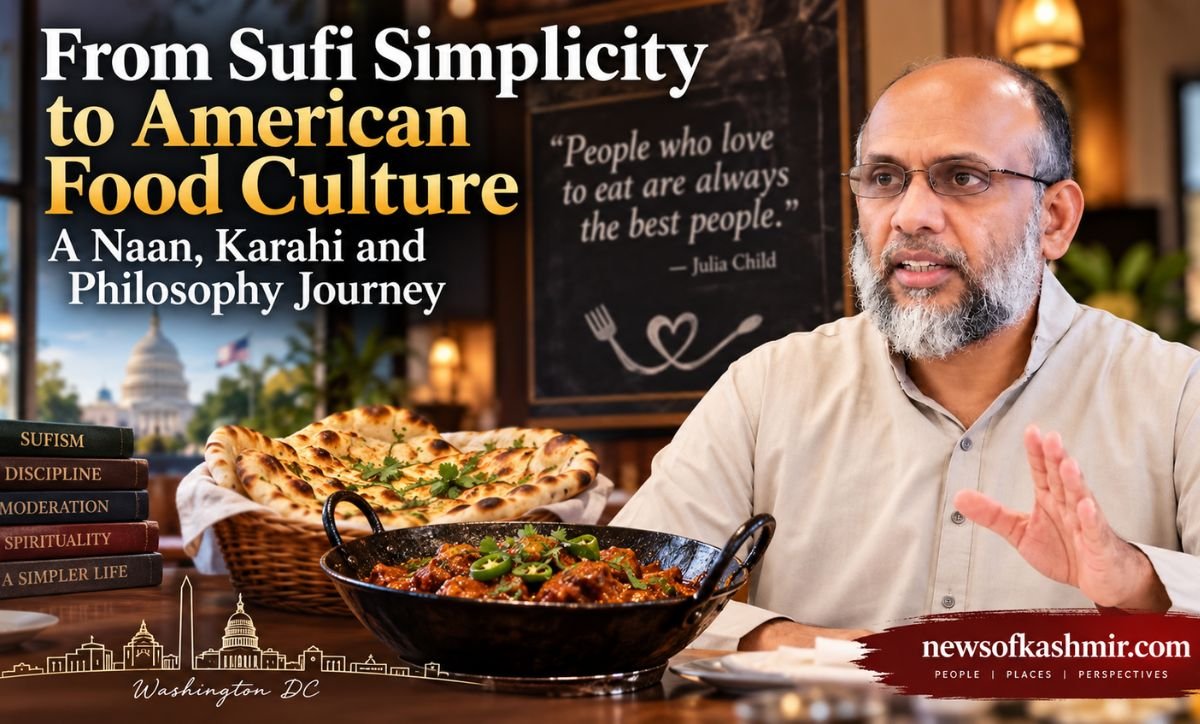
My recent trip to the United States was different from previous visits in many respects. This time around, I heard more conversation about food than I perhaps ever had before. It felt as though American society—having mastered science, technology, politics, and economics—has now formally recognized food as a serious academic discipline. Click Here To Follow Our WhatsApp Channel
Among the people I met were some whose knowledge of famous American restaurants made me feel thoroughly embarrassed by my own ignorance. They would comfortably detail which restaurant in which city was renowned for a particular dish, which chef was world-famous, and what specific item one simply must try at a given location. I even discovered that a few of them were deeply familiar with London’s dining scene—even though, living in London, I had never researched it as thoroughly as they had from across the Atlantic.
I began to think that my upbringing must have been flawed. Back home, food was mentioned with a certain caution. A heavy eater was rarely called a “gourmet”; they were labeled a glutton. If someone praised food with too much enthusiasm, their spiritual discipline was immediately called into question. The Sufis always counted eating less, sleeping less, and speaking less among the steps toward spiritual elevation. In the gatherings of the pious, one was reminded to eat only enough to keep the body going; eating beyond that strengthens the lower self (nafs) and weakens the soul.
Upon arriving in Washington, however, I realized times had changed.
One day, I went to a Pakistani restaurant in Washington with Moazzam and Dr. Imran. The naan and karahi there were so delicious that, for a fleeting moment, I wondered if the Sufis had recommended light eating simply because they had never experienced hot naan and a freshly made Pakistani karahi. At any rate, we finished our meal, leading me to conclude that while debates on culture and civilization have their place, a hot piece of naan sways a human being much faster than philosophy.
But the real shock was yet to come.
My eyes caught a quote on the restaurant wall:
“People who love to eat are always the best people.”
— Julia Child
I stood frozen for a few moments reading it. I read it a second time, then a third, thinking my English might be playing tricks on me. But the words remained unchanged. I immediately drew Moazzam and Dr. Imran’s attention to it and expressed my utter shock.
I said: “What is happening here? Back home, a person would confess a love for food only with a bit of embarrassment, yet here it is proudly proclaimed that those who love to eat are the best people!”
This was nothing short of a complete rewrite of moral philosophy.
For centuries, we taught people to eat less, control their desires, suppress their appetites, and refrain from turning their stomachs into graveyards. Sufis engaged in spiritual struggle (mujahadah), scholars detailed the virtues of ascetic moderation, and elders viewed restraint at the table as a cornerstone of refined manners.
Extraordinary fondness for food was rarely viewed as a virtue; it was seen as a sign of greed, indulgence, or weakness.
And now, in Washington, a lady announces to the whole world that whoever loves food is the finest type of human being!
Were we wrong for all those centuries?
Was the virtue of asceticism and piety merely a misunderstanding?
Did our elders say “eat less” simply because they didn’t know about good karahi?
And the most critical question of all: if a love for food makes someone the best of people, does that mean those waiting outside a restaurant for three hours just to get a table are actually the most righteous and pure among us?
I looked at Moazzam and Dr. Imran. Both sat between the naan and karahi looking completely content, as if a centuries-old philosophical dispute had just been settled right before their eyes.
I thought to myself: perhaps times truly have changed. In our tradition, people used to ask, “How much did you eat?”—a question laden with concern.
Now, they ask, “Where did you eat?”—a question brimming with pride!
Once, a good person was someone who exercised self-control over their desires; now, a good person is simply someone who remembers the names of all the best restaurants.
At any rate, I pondered this quote at length. Then, I broke off another piece of naan, dipped it into the karahi, and thought that if loving food truly makes a person the best of human beings, then at least on that day in Washington, the three of us were making significant progress in our moral development.
However, one thing still remains incomprehensible to me:
If those who love to eat are indeed the best people, then why did the Sufis insist on putting us through so much light eating?
Perhaps the answer to this question, too, is written on the wall of some restaurant—our eyes just haven’t caught it yet.

You Might Also Like:
Education In Kashmir with Complete Statistics
TCS Nashik ‘Conversion’ Scandal: Accused Nida Khan Suspended as Sexual Harassment and Coercion Probe Intensifies