SCERT Kashmir Conducts Three-Day Training Programme on New NCERT Mathematics Textbooks Under NEP 2020
By : sheikh Mohammad Isa
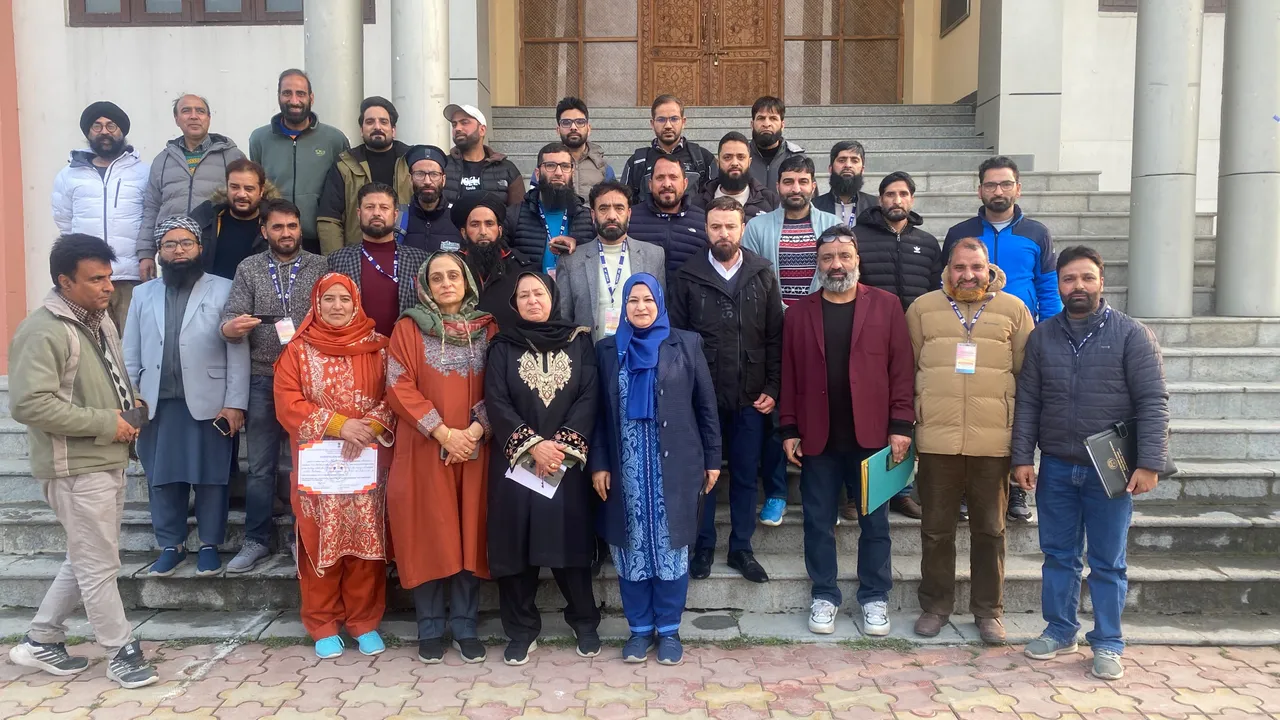
The State Council of Educational Research and Training (SCERT), Jammu and Kashmir, Divisional Office Kashmir, conducted a three-day capacity-building programme on the effective teaching of newly developed NCERT Mathematics textbooks in accordance with NEP 2020 and the National Curriculum Framework (NCF). Click Here To Follow Our WhatsApp Channel
The programme was held from November 26 to 28, 2026, at the SCERT Complex, Bemina, Srinagar, and was organised by the Department of Education in Science and Mathematics (ESM), SCERT Kashmir Division.
The initiative aimed to familiarise teachers and academic resource persons with the pedagogical vision, curricular changes and innovative teaching approaches incorporated in the newly developed NCERT Mathematics textbooks.
The programme focused on strengthening teachers’ capacity to move beyond conventional textbook-based teaching towards competency-based, experiential and activity-oriented mathematics education.
It was conducted under the leadership of SCERT J&K Director Dr Naseem Javaid Chowdhury, JKAS, with the guidance and support of Joint Director SCERT Kashmir, Syed Shabir Ahmad, JKAS.
The inaugural session was attended by faculty members of SCERT Kashmir Division, Academic Unit Heads of Units I, II and III, resource persons and participating trainees.
Javid Ahmad Dar from the Department of Education in Science and Mathematics delivered the welcome address, highlighting the importance of the programme in the context of ongoing curricular and pedagogical reforms.
The proceedings were moderated by Dr Fauzia, while Sheikh Iqbal from the ESM Wing also contributed to the academic sessions.
Focus on NEP 2020 and Mathematics Education
The first academic session was conducted by Gulzar Ahmad Dar, Senior Academic Officer, SCERT Kashmir Division, and Coordinator of the programme.
His session focused on the vision of NEP 2020 and the National Curriculum Framework, particularly their implications for mathematics education.
He emphasised the need to shift teaching practices from rote memorisation and procedural learning towards conceptual understanding, mathematical reasoning, critical thinking, problem-solving and the application of mathematical concepts in real-life situations.
He explained that mathematics education should encourage students to explore patterns, develop mathematical intuition, formulate conjectures and apply their understanding to unfamiliar situations.
The session provided a conceptual foundation for subsequent discussions on the effective implementation of the newly developed textbooks.
Teachers Oriented Towards New NCERT Mathematics Textbooks
Another session focused on competency-based education and the curricular and pedagogical changes reflected in the newly developed NCERT Mathematics textbooks.
Participants were introduced to the textbook content, illustrations, activities and exercises designed to promote conceptual understanding, mathematical thinking and competency development.
A detailed session on the Class VI Mathematics textbook was conducted by Sheikh Bashir Ahmad, a resource person in Mathematics.
He explained various chapters, activities and pedagogical features of the textbook, demonstrating how teachers could effectively implement these activities in classroom settings.
He stressed that textbook activities should not be treated merely as supplementary exercises but as integral components of the teaching-learning process.
Emphasising experiential and activity-based learning, he said students should be encouraged to develop mathematical understanding through exploration, observation, discussion, hands-on activities and problem-solving.
He highlighted the importance of teachers facilitating learning experiences that enable students to discover mathematical concepts and relationships themselves.
Competency-Based Assessment and Digital HPC
On the concluding day, Dr Amjad from SCERT Kashmir Division conducted a session on competency-based assessment in Mathematics.
He explained the significance of assessing students’ understanding, skills and competencies through activities incorporated in the newly developed NCERT textbooks.
The session emphasised aligning classroom assessment with learning outcomes and competencies rather than relying primarily on conventional examination practices focused on memorisation.
He also discussed the role of the Digital Holistic Progress Card (Digital HPC) in documenting students’ progress and capturing their overall development through appropriate assessment practices.
Activity-Based Learning and Classroom Implementation
Sheikh Iqbal from the ESM Wing, SCERT Kashmir Division, conducted another session focusing on mathematical activities included in the newly developed textbooks.
He explained their pedagogical significance and demonstrated how teachers could use them to encourage active participation, mathematical exploration, collaborative learning and problem-solving skills.
The session provided practical insights into translating textbook activities into meaningful classroom experiences.
Programme Concludes with Certificate Distribution
During the valedictory session, Shakeel Ahmad Bhat, Academic Unit Head-II, SCERT Kashmir Division, addressed the participants.
He emphasised the importance of competency-based mathematics education and encouraged teachers to adopt innovative, learner-centred and activity-oriented pedagogical practices.
He observed that the newly developed NCERT textbooks offer significant opportunities for developing mathematical competencies, adding that their effective implementation requires teachers to understand the underlying pedagogical philosophy rather than merely completing the prescribed syllabus.
Certificates were distributed among participants, while feedback was also collected. Participants expressed satisfaction with the academic deliberations, practical orientation and interactive nature of the programme.
They appreciated SCERT Kashmir Division for organising the capacity-building initiative and expressed hope that similar programmes would continue to strengthen the professional competencies of mathematics teachers.
The three-day programme provided an academic platform to discuss the changing landscape of mathematics education under NEP 2020 and NCF, reinforcing the importance of conceptual understanding, experiential learning, activity-based pedagogy, competency-based assessment and innovative learning resources.
Through the initiative, SCERT Kashmir Division reaffirmed its commitment to strengthening teachers’ professional capacity and promoting quality, competency-oriented mathematics education across Jammu and Kashmir.