By : Gluf Media Reports
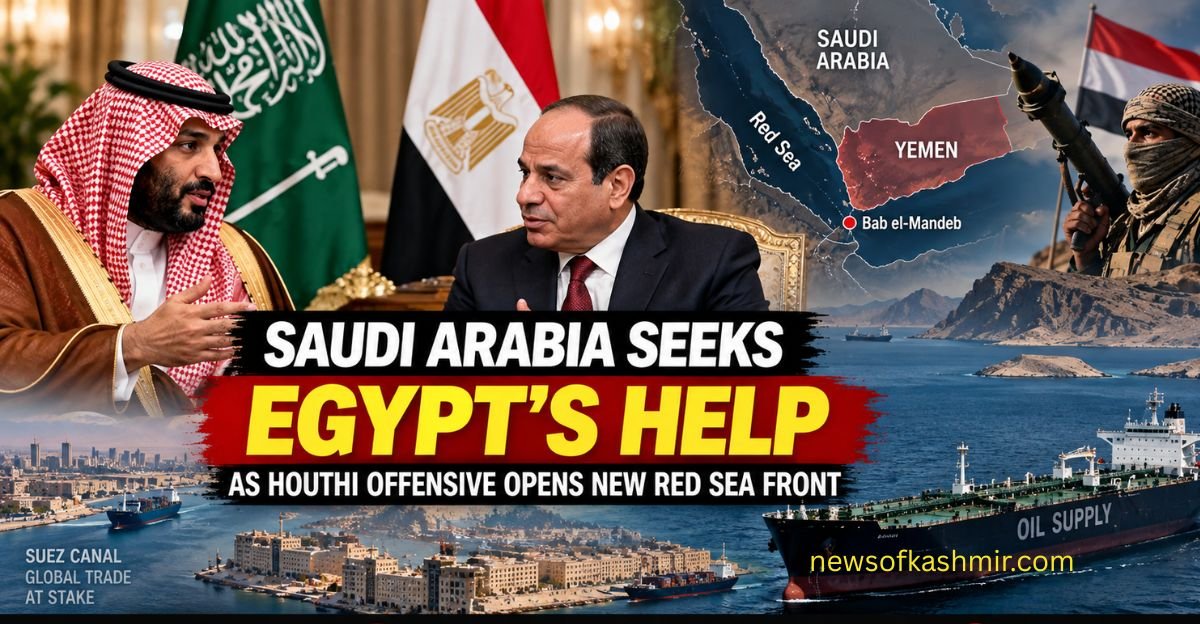
Cairo: Saudi Arabia is seeking stronger political backing from Egypt as Yemen’s Houthi movement intensifies attacks on Saudi territory, shipping and energy infrastructure, opening a new front around the Red Sea.
Saudi Crown Prince Mohammed bin Salman met Egyptian President Abdel Fattah el-Sissi in Cairo on Tuesday as the crisis around Yemen’s Red Sea coast deepened. The talks came as the Houthis expanded their control around the southern entrance to the Red Sea and increased pressure on Saudi maritime and oil routes. Click Here To Follow Our WhatsApp Channel
Following the meeting, Saudi Arabia and Egypt stressed their shared commitment to freedom and security of navigation in the Red Sea and the Bab el-Mandeb Strait. Egypt also reaffirmed its support for Saudi Arabia, although neither side announced a new military deployment or a specific joint operation against the Houthis.
The meeting underlined Egypt’s importance to Saudi Arabia. Egypt controls the Suez Canal, while Saudi Arabia relies on Red Sea routes as an alternative pathway for some oil exports when the Strait of Hormuz is threatened.
Houthi advance raises Red Sea fears
The latest escalation has changed the security picture around Yemen’s western coast. The Houthis have made significant gains in areas overlooking the Red Sea and the Bab el-Mandeb, a narrow waterway connecting the Red Sea with the Gulf of Aden.
Their increased presence around the strait has raised concerns over Saudi oil shipments and international commercial traffic. The Bab el-Mandeb is a major maritime chokepoint linking routes between the Indian Ocean, Red Sea and Suez Canal.
The Houthis have announced attacks against Saudi targets and vessels, while Saudi Arabia has carried out strikes against Houthi positions in Yemen. Both sides have presented their actions as responses to attacks by the other.
Saudi oil infrastructure under pressure
Saudi Arabia’s vulnerability has also been highlighted by an attack on its East-West oil pipeline.
Saudi authorities said drones launched from Iraqi territory struck the pipeline, while an investigation was launched in Iraq. No group immediately claimed responsibility. The damage forced Saudi Arabia to temporarily shut the 1,200-kilometre pipeline.
The pipeline carries oil from Saudi Arabia’s eastern production areas towards the Red Sea, allowing exports to avoid the Strait of Hormuz.
The disruption comes as regional oil routes are already under pressure, increasing concerns about global energy supplies.
Mecca alert raises the stakes
The security situation took on a more sensitive dimension when Saudi air defences intercepted and destroyed a drone south of Mecca on Tuesday evening.
Saudi coalition spokesman Major General Turki Al-Malki said the drone was destroyed before entering restricted airspace around the holy city. He described the security of the Two Holy Mosques and pilgrims as a “red line”.
Saudi Arabia said the incident represented the second reported attempt by the Houthis to target Mecca, referring to a ballistic missile incident in 2017.
The Houthis rejected the allegation. Their military spokesperson Yahya Saree said the movement targets Saudi military and economic facilities and denied targeting Islamic holy sites.
The competing accounts remain disputed, adding a sensitive religious dimension to the widening conflict.
Why Egypt matters
Egypt’s role is important because its interests are directly affected by instability in the Red Sea.
Houthi attacks on commercial shipping have previously reduced traffic through the Suez Canal, cutting an important source of Egyptian revenue. A prolonged disruption around the Bab el-Mandeb could again affect ships travelling between Asia and Europe.
Cairo also has political influence across the Arab world, giving Egypt a diplomatic role.
For Riyadh, Egyptian political support could strengthen the Arab position on maritime security without immediately requiring a large Egyptian military commitment.
No Egyptian military commitment announced
Despite the high-level meeting, there was no public announcement that Egypt would send forces to Yemen.
Saudi Arabia has faced difficulties maintaining a broad military coalition against the Houthis since its intervention began in 2015. The earlier coalition weakened amid disagreements among its members and competing interests inside Yemen.
Riyadh therefore faces a difficult balance. A major military escalation could push back Houthi advances, but it could also expose Saudi cities, oil facilities and shipping routes to further attacks.
A diplomatic approach could reduce the risk of a wider war but would not immediately remove the security threat around the Red Sea.
Wider regional pressure
The Saudi-Egyptian talks come as Riyadh seeks support from other partners.
Saudi Arabia has defence ties with Pakistan and Türkiye, while the United States remains a major security partner. However, public statements from these countries have not resulted in an announced foreign military deployment against the Houthis.
Israel has reportedly been involved in intelligence discussions with Saudi Arabia, according to regional media reports, but the two countries do not have formal diplomatic relations.
The different responses underline the complexity of the crisis as outside powers weigh the risks of direct involvement.
Yemen’s humanitarian crisis
The renewed fighting is also worsening conditions inside Yemen.
Humanitarian organisations have reported displacement and rising civilian casualties. Millions of Yemenis depend on aid.
A prolonged confrontation around the Red Sea could further complicate humanitarian operations, particularly if ports and transport routes become unsafe.
What comes next
The meeting between Mohammed bin Salman and el-Sissi does not by itself signal a new military alliance against the Houthis. Instead, it shows how the conflict is pushing Saudi Arabia to seek wider regional support.
The central concern is now the security of the Red Sea and Bab el-Mandeb. If Houthi attacks continue and the group retains control around the waterway, pressure on Saudi oil exports and international shipping could increase.
For Egypt, keeping the Red Sea and Suez Canal open is both an economic and security priority. For Saudi Arabia, the issue is increasingly tied to protecting its territory, energy infrastructure and Islamic holy sites.
The coming days will show whether the Saudi-Egyptian understanding remains diplomatic or develops into a broader regional response. For now, both governments are emphasising maritime security as the Yemen conflict continues to expand.
You Might Also Like:
Education In Kashmir with Complete Statistics
TCS Nashik ‘Conversion’ Scandal: Accused Nida Khan Suspended as Sexual Harassment and Coercion Probe Intensifies