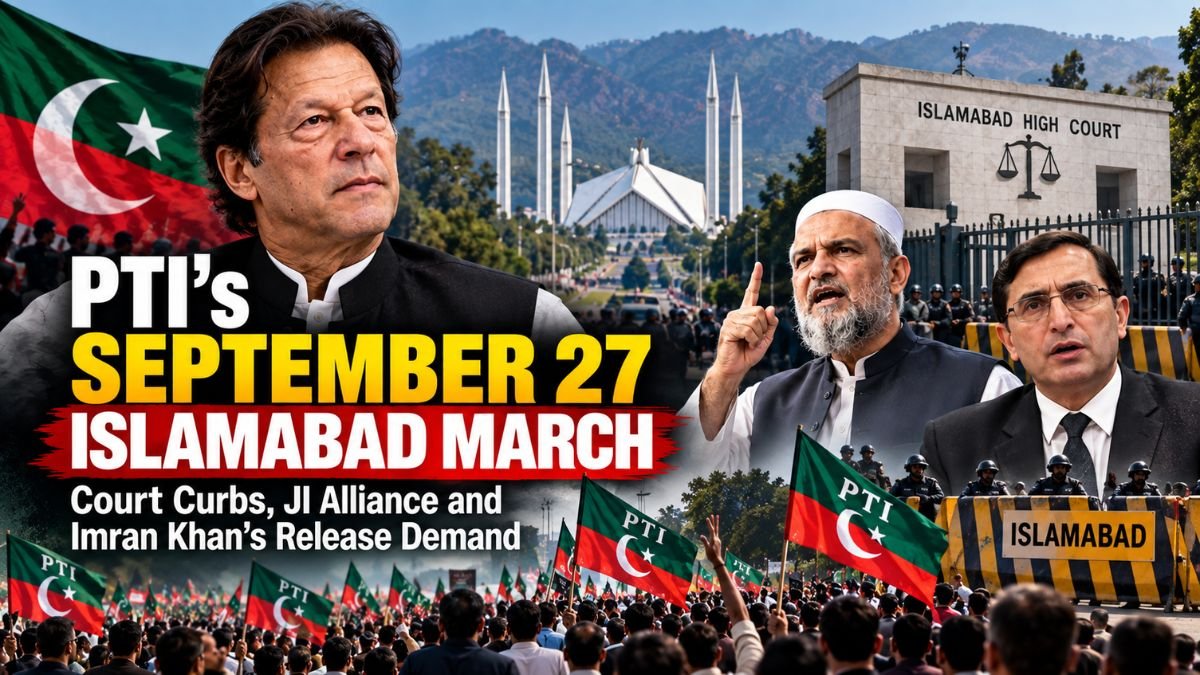
ISLAMABAD: Political tensions in Pakistan are rising ahead of Pakistan Tehreek-e-Insaf’s (PTI) planned nationwide protest and march towards Islamabad on September 27, 2026. The planned mobilisation is gaining further attention after the Islamabad High Court (IHC) issued directions aimed at preventing disruption of public life and the use of government resources for political activity. Click Here To Follow Our WhatsApp Channel
PTI has said the protest will focus on the release of party founder and former prime minister Imran Khan, implementation of court orders and what it describes as the supremacy of the Constitution. The party has also been seeking greater political support as it prepares for what could become one of its biggest street mobilisations of the year.
The situation has become more complicated because Jamaat-e-Islami (JI), which is separately leading protests over inflation and the petroleum levy, has indicated support for PTI’s September 27 mobilisation. PTI Chairman Barrister Gohar Ali Khan has also announced support for JI’s campaign and said his party would invite JI to join the September 27 march.
IHC Tightens Rules Ahead of September 27
The Islamabad High Court on Monday delivered its decision on a petition concerning the planned PTI protest.
A three-member larger bench headed by Chief Justice Sardar Muhammad Sarfraz Dogar ruled that political parties cannot block public places or obstruct the movement of citizens. The court directed the administration to ensure that major roads in Islamabad remain open and that normal activities are not unnecessarily disrupted during protests.
The court also directed provincial governments, particularly chief ministers, to ensure that government machinery and public resources are not used for political protests or marches.
The ruling is significant for PTI because its planned mobilisation is expected to bring supporters from different parts of Pakistan towards the federal capital.
The court’s decision does not simply amount to a ban on the protest. Instead, it places clear limits on how a political demonstration can be organised and how public roads and state resources may be used.
PTI Says March Will Be Peaceful
PTI Chairman Barrister Gohar Ali Khan has repeatedly described the September 27 demonstration as peaceful.
Gohar has said that the party is not planning to storm Adiala Jail or “conquer” Islamabad. Instead, he says PTI supporters will come to the capital to demand their political rights and the implementation of court orders concerning Imran Khan.
PTI has also said that provincial government resources will not be used for the protest.
The party’s position is important because the use of official vehicles, government machinery or administrative resources has become a major point of concern in the legal proceedings.
The IHC also heard arguments concerning previous PTI protests, including allegations of damage to public property and clashes during demonstrations in 2022 and 2024. Government lawyers argued that lessons from those incidents should be considered when dealing with the September 27 mobilisation.
Imran Khan’s Release Remains at the Centre
The release of Imran Khan remains one of the main demands behind the PTI campaign.
The party has repeatedly demanded that cases involving Khan and his wife, Bushra Bibi, be heard and decided on merit. PTI leaders have also raised concerns about access to Khan by his lawyers, doctors, relatives and party leaders.
In recent weeks, PTI has increasingly linked the protest to wider demands for the rule of law and constitutional rights.
Gohar said at a lawyers’ convention in Lahore that the September 27 mobilisation would be a peaceful “Justice March” and called on political parties, lawyers and members of the public to participate.
For PTI, the march therefore serves two purposes: putting pressure on the government over Imran Khan’s imprisonment and demonstrating that the party remains capable of mobilising supporters across the country.
JI Adds Another Dimension to the Protest Politics
The involvement of Jamaat-e-Islami could make the political situation more significant.
JI has been holding protests and sit-ins over inflation, taxation and the petroleum levy. Its leader, Hafiz Naeemur Rehman, has demanded the withdrawal of what he describes as an unjust petroleum levy and has called for relief for ordinary citizens.
JI has also urged opposition parties to support its campaign. Hafiz Naeem said PTI Chairman Gohar had assured cooperation.
Gohar subsequently announced that PTI supported JI’s sit-ins and said the party would invite JI to join the September 27 long march.
This does not necessarily mean that PTI and JI have formed a permanent political alliance. Their immediate interests, however, overlap on several issues, particularly public economic pressure and opposition to government policies.
JI is focused mainly on inflation, fuel prices and the petroleum levy, while PTI’s central demands include Imran Khan’s release, political rights and constitutional rule.
That overlap could bring supporters of two different political movements onto the streets at the same time.
A Wider Opposition Front May Be Taking Shape
The political activity around September 27 is not limited to PTI and JI.
PTI leaders have also been holding discussions with other opposition groups. On September 11, Gohar met leaders of Jamiat Ulema-e-Islam-Fazl (JUI-F), with discussions reportedly covering the September 27 call, rule of law and constitutional supremacy.
This suggests that PTI is attempting to broaden its political reach beyond its own traditional support base.
However, whether other opposition parties eventually join the march remains uncertain.
Why the Court’s Decision Matters
The IHC ruling places the PTI protest in a clear legal framework.
The court has made it clear that the right to protest cannot be used to prevent ordinary citizens from travelling, working or conducting business. At the same time, political parties retain the right to organise lawful political activities.
The Attorney General also argued during the proceedings that the right to protest cannot come at the expense of the rights of other citizens. He referred to violence and property damage during previous PTI demonstrations as reasons for stronger precautions.
The challenge for the authorities will therefore be to maintain public order without creating a situation in which restrictions themselves become another source of political confrontation.
PTI Faces a Major Mobilisation Test
For PTI, September 27 will be an important test of its organisational strength.
Imran Khan remains in prison, meaning the party has to rely on its existing leadership structure and provincial organisation to bring supporters to Islamabad.
PTI has already been working to mobilise supporters in different parts of the country, while Khyber Pakhtunkhwa Chief Minister Sohail Afridi has been actively campaigning for participation in the protest.
The party will need to balance two competing objectives: attracting a large crowd while ensuring that the demonstration remains within the legal limits set by the court.
A large turnout could strengthen PTI’s political message. But clashes, road blockages or damage to public property could create serious legal and political consequences.
Government Faces Its Own Challenge
The government, meanwhile, faces the difficult task of enforcing the court’s directions without allowing the situation to escalate.
Authorities have been directed to keep major roads open and prevent the misuse of government machinery. At the same time, excessive restrictions could potentially increase tensions between the government and PTI supporters.
The government will also have to deal with JI’s separate mobilisation over economic issues.
With JI focusing on inflation and petroleum prices and PTI focusing on Imran Khan’s release and constitutional issues, public dissatisfaction could become a common factor linking otherwise separate protest movements.
What Happens Next?
The coming days are likely to be crucial.
PTI is expected to continue its mobilisation campaign before September 27, while the government and security authorities will prepare for a possible large gathering in Islamabad.
JI’s own protest campaign could add further pressure, while contacts between PTI and other opposition parties may determine whether the September 27 mobilisation remains primarily a PTI event or develops into a broader opposition movement.
For now, the IHC has drawn a clear line: political parties may protest, but they cannot obstruct citizens or use state resources for partisan activity.
The real test will come on September 27, when PTI’s political demands meet the government’s responsibility to maintain public order.
With Imran Khan’s release at the centre of PTI’s campaign, growing support from opposition groups and tighter judicial restrictions, the September 27 march could become a major test of Pakistan’s already tense political environment.
You Might Also Like:
Education In Kashmir with Complete Statistics
TCS Nashik ‘Conversion’ Scandal: Accused Nida Khan Suspended as Sexual Harassment and Coercion Probe Intensifies