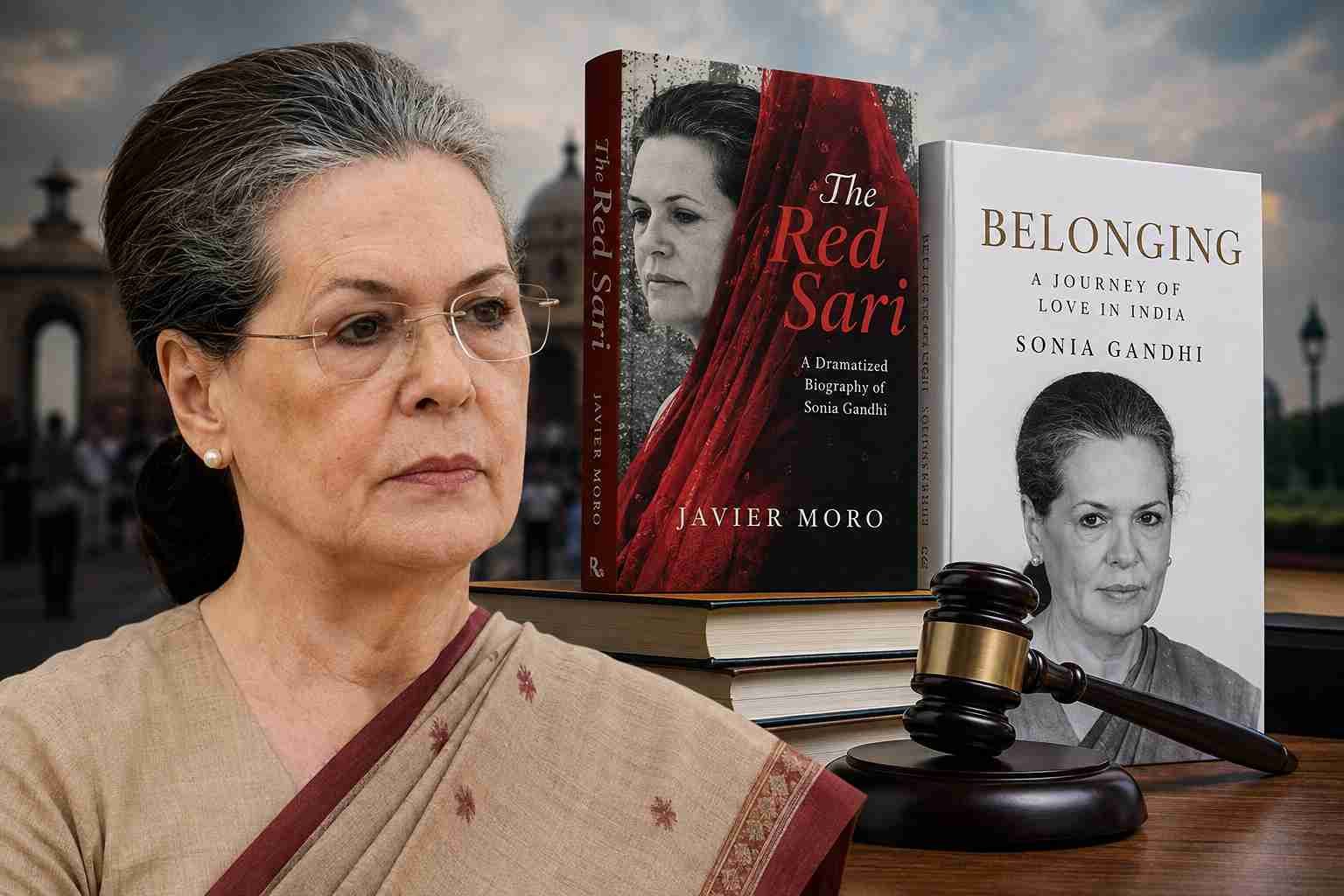
Why Sonia Gandhi’s Books Sparked Major Controversies Before Publication in India
Sonia Gandhi, former president of the Indian National Congress and one of the most influential figures in Indian politics, has long kept her personal life private.
Because of this, books about her life have often attracted intense political and legal attention. Her journey from childhood in Italy to marriage into the Nehru-Gandhi family and later her rise in Indian politics has been the subject of several controversies. Click Here To Follow Our WhatsApp Channel
Two books, in particular, have faced major disputes before publication in India: Javier Moro’s The Red Sari and Sonia Gandhi’s own memoir, Belonging: A Journey of Love in India.
While the two controversies are very different, both highlight how sensitive Sonia Gandhi’s personal and political life has remained.
The Red Sari: Javier Moro’s Controversial Biography
Spanish author Javier Moro’s The Red Sari was first published in Spanish in 2008. The book was described as a dramatised biography of Sonia Gandhi and became an international bestseller.
However, its publication in India became a major political and legal issue.
What was The Red Sari about?
The book follows Sonia Gandhi’s life from her childhood in Italy to her marriage to Rajiv Gandhi and her eventual involvement in Indian public life.
It also describes the difficult years following the assassinations of her mother-in-law, former Prime Minister Indira Gandhi, and her husband, Rajiv Gandhi.
Moro presented the story using a mixture of historical events and dramatised conversations.
Why did Congress object?
The Congress party strongly opposed the proposed publication of the book in India.
The party’s legal cell, led by senior Congress leader Abhishek Manu Singhvi, sent defamation notices to Moro. Congress representatives argued that the book contained inaccurate claims and invented conversations.
Moro, however, defended the book by saying that its main facts were accurate and that the conversations were part of the literary style used in a dramatised biography.
Some passages were particularly sensitive for the Congress party. One of them suggested that Sonia Gandhi had considered returning to Italy with Rajiv Gandhi and their children during the Emergency period in 1977.
The book also dealt extensively with Sonia Gandhi’s Italian background. Moro argued that there had been an effort to present her as completely Indian while ignoring parts of her earlier life.
When was The Red Sari published in India?
Moro later accused the Congress party of creating an atmosphere of fear around the book and said that publishers had been discouraged from bringing out an English edition in India.
The book was eventually published in India by Roli Books in January 2015, after the Congress-led government had lost power at the Centre.
The controversy surrounding The Red Sari became one of the most prominent examples of the political sensitivity surrounding books about Sonia Gandhi.
Sonia Gandhi’s Memoir: Belonging
More than a decade later, another controversy emerged around a book about Sonia Gandhi — this time, one written by Sonia Gandhi herself.
Her much-anticipated autobiography, Belonging: A Journey of Love in India, is expected to provide a personal account of her life, relationships, grief and years in Indian politics.
The memoir has attracted particular attention because of Sonia Gandhi’s long-standing reluctance to discuss many private aspects of her life publicly.
Why Did the Memoir Become Controversial?
In August 2026, reports emerged that Penguin Random House India would not publish the memoir in India, despite the book being scheduled for international publication.
Reports suggested that disagreements had emerged over parts of the manuscript and that the Indian publisher had sought changes or deletions.
Sonia Gandhi was reportedly unwilling to accept the proposed changes.
The development quickly turned into a political controversy.
Congress Raises Questions Over Political Pressure
Congress leaders and political commentators questioned whether political pressure had influenced the publisher’s decision.
Congress MP Gaurav Gogoi criticised the situation, arguing that publishers appeared willing to publish books supporting right-wing views while showing greater caution over what Sonia Gandhi might reveal in her memoir.
Questions were also raised about why the international publication of the book was continuing while the Indian arm of the publisher had decided not to release it.
What Did Penguin Random House India Say?
Penguin Random House India rejected claims that it had withdrawn from the project simply because Sonia Gandhi refused editorial changes.
The publisher said reports suggesting this were inaccurate.
At the same time, it pointed out that fact-checking manuscripts and making editorial recommendations are normal parts of the publishing process.
This statement added another layer to the dispute, as it confirmed that editorial discussions had taken place even though the publisher disputed the way those discussions had been described.
What Happens to the Book Now?
The international edition of Belonging: A Journey of Love in India, published by Alfred A. Knopf, is continuing as planned.
Meanwhile, the question of who will publish and distribute the memoir in India has attracted considerable interest. Reports have suggested that other major publishers, including HarperCollins, may become involved.
The dispute has therefore raised wider questions about editorial independence, political pressure and the freedom to publish controversial political material in India.
Why Sonia Gandhi’s Books Create So Much Debate
The controversies surrounding The Red Sari and Belonging are separated by many years and involve different circumstances.
The first involved a foreign author writing a dramatised biography of Sonia Gandhi. The second concerns Sonia Gandhi telling her own story in an autobiography.
Yet both cases demonstrate why books about her life can become politically sensitive.
Sonia Gandhi has played a major role in Indian politics for decades while maintaining a relatively private public image. As a result, details about her family, personal experiences, political decisions and Italian roots have attracted enormous public interest.
The highly polarised nature of Indian politics has also made biographies and memoirs of major political figures particularly sensitive.
For supporters, such books can provide an important insight into a political leader’s life. For critics, they can become a source of political debate and scrutiny.
In Sonia Gandhi’s case, the history of The Red Sari and the controversy surrounding Belonging show that the debate over her life extends well beyond politics and into the world of publishing, free expression and editorial independence.
You Might Also Like:
IGP Kashmir Sujit Kumar Says Anti-Terror Operations Remain Top Priority
Two Hand Grenades Recovered During Naka Checking in Baramulla’s Kunzer
Aga Ruhullah Mehdi Says He Will Resign as Srinagar MP and Quit National Conference on November 3