
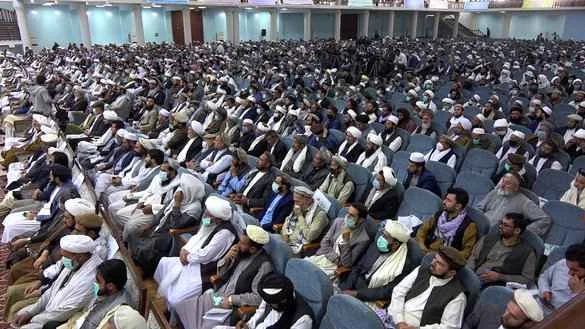
A major gathering was held at Kabul University where more than one thousand Afghan Islamic scholars, religious leaders, and political figures came together to discuss the issue of security and foreign militancy. At the end of this meeting, a joint declaration was released, and its message was very clear: no Afghan is allowed to leave the country to take part in armed fighting abroad.Click Here To Follow Our WhatsApp Channel
Clear Message from Afghan Religious Leaders
The declaration stated that going outside Afghanistan for military operations is not permitted under Islamic law. The scholars stressed that anyone who tries to travel to another country for fighting is acting against the teachings of Islam and the rules of the Afghan state.

In the fourth point of the declaration, the scholars strongly urged the Islamic Emirate — the Taliban government — to take firm and necessary action to stop such individuals. They also called for anyone who breaks this rule to be labelled as a rebel and someone who disobeys the authority of the Islamic Emirate.
This part of the declaration is seen as especially important because it directly concerns cross-border militancy. Neighbouring countries, such as Pakistan, have long raised concerns that armed groups use Afghan soil to plan or launch attacks. The joint statement appears to respond to these concerns by publicly confirming that such activities must not be allowed.
Taliban Supreme Leader Reinforces the Ban
The Taliban’s supreme leader, Hibatullah Akhundzada, has spoken many times about this issue. He has clearly said that fighting outside Afghanistan cannot be called jihad. Instead, he describes it simply as war — and such war is forbidden.
Afghanistan’s Defence Minister, Mohammad Yaqoob Mujahid, repeated this message during a televised address to the country’s security forces. He explained that if any individual leaves Afghanistan to fight in another country without the direct permission of the Amir-ul-Mu’mineen (Supreme Leader), then this action is not considered jihad. Instead, it is an act of disobedience against the Islamic Emirate.
His message was firm: no Afghan fighter should cross the border for armed operations without official approval, and doing so brings harm to both the country and its laws.
Part of International Assurances
The Taliban’s position on foreign fighting is also connected to their commitments to the international community. Since taking control of Afghanistan in 2021, the Taliban have repeatedly promised countries such as Pakistan, China, Iran, and the United States that Afghan territory will not be used by militant groups to harm other nations.
Although these assurances exist, many nations have argued that enforcement remains inconsistent. Various governments and organisations have expressed doubts about whether the Taliban are fully capable of controlling all militant groups operating within Afghanistan.
Even so, this new declaration from both scholars and political leaders is seen as an attempt to strengthen Afghanistan’s official policy and show the world that the Taliban leadership does not support cross-border violence.
Importance for Regional Peace
The statement from Kabul University is viewed as part of a wider effort to bring stability to the region. Afghanistan is located in a sensitive geographical area, sharing borders with Pakistan, Iran, China, and Central Asian countries. Any movement of fighters across these borders can quickly lead to tension, conflict, or diplomatic pressure.
By openly declaring that foreign fighting is illegal, the Afghan scholars aim to reduce misunderstandings and to reassure neighbouring countries. Regional peace can only be maintained if Afghanistan itself prevents any group from using its land to start conflicts elsewhere.
A Step Toward Internal Control
Inside Afghanistan, this decision is also seen as a move to strengthen the government’s authority. By labelling unauthorised fighters as rebels, the Taliban are trying to stop internal groups from acting independently. The government wants to show that only the central leadership has the right to make decisions about national security and military matters.
This approach may help the Islamic Emirate bring more discipline within its ranks and reduce the influence of independent armed groups.
Conclusion
The joint declaration by Afghan scholars, combined with repeated instructions from the Taliban leadership, marks an important moment in Afghanistan’s security policy. The message is simple: no Afghan is allowed to take part in armed operations outside the country. Those who do so without permission will be treated as disobedient rebels.
Whether this policy will be fully enforced remains a question, but it is seen as a significant step toward improving regional peace and shaping Afghanistan’s future direction.
You Might Also Like:
Islam’s Unique Civilisation: Unity of Faith, Culture and History
Nawada Man Forced to Push Mother’s Body on Stretcher for 2 km After Ambulance Denied
Is Crowdfunding and Taking Loans Allowed in Islam? Understanding Help, Tawakkul and Riba